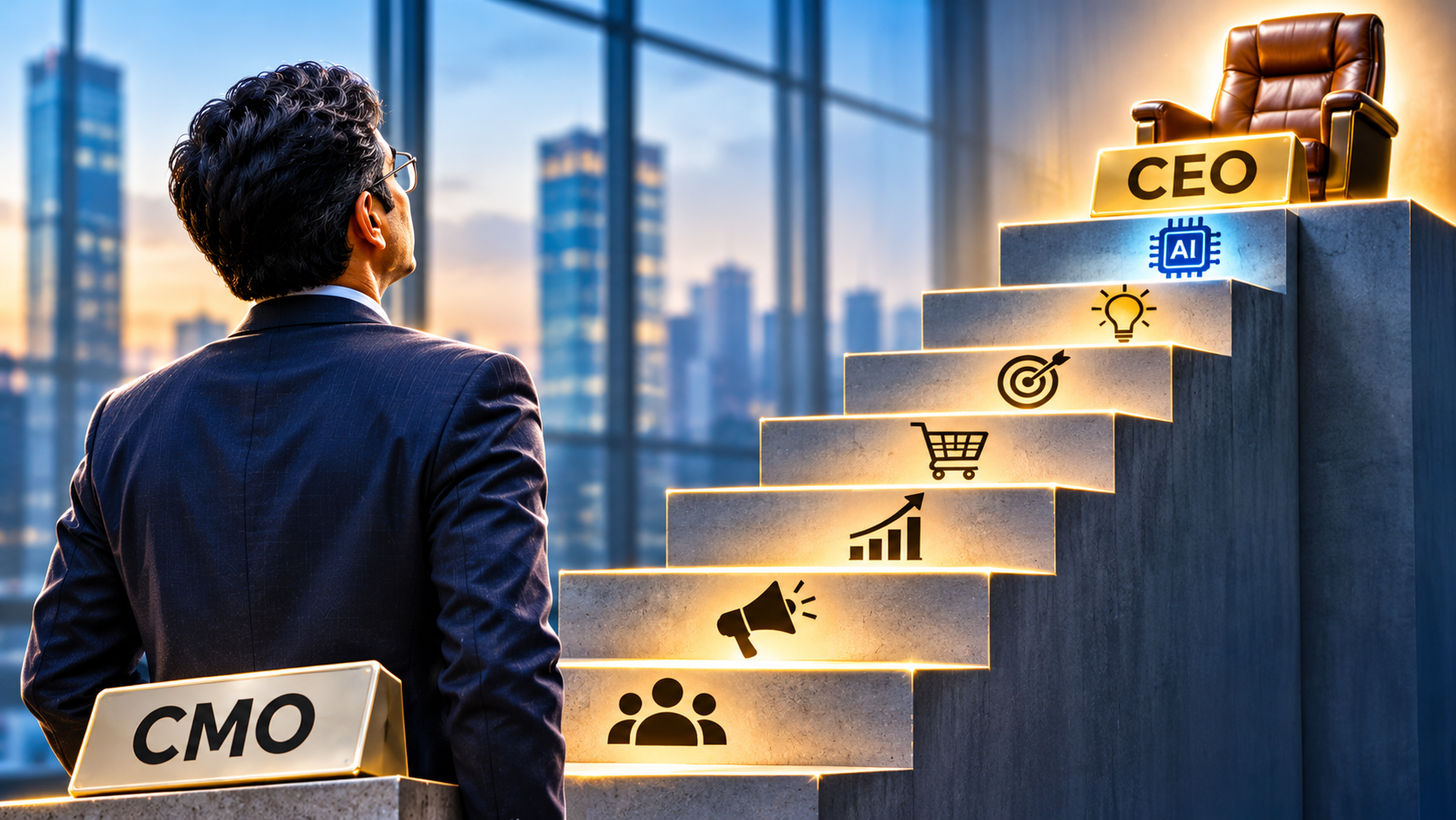
Ten years of hitting every target. A stellar record of driving growth and profitability. A career spanning some of India's biggest consumer brands. Yet, the one position that continues to elude Samir is the CEO's chair.
An IIM alumnus who now heads marketing for one of India's largest direct-to-consumer (D2C) platforms, Samir has spent much of his career building brands and growing businesses. Before his current role, he worked with a leading FMCG multinational whose products ranged from detergents and personal care to frozen foods. When I met him recently, I was struck by the irony: despite his impressive track record, the corner office remains out of reach.
Samir isn't alone. Consider Rathna, a marketing veteran with 25 years of experience in B2B industrial products. Now in her ninth year heading marketing for a multinational group, she has even led a successful turnaround of its European marketing operations. Yet, she has been passed over three times for country head positions in India, the Middle East and North Africa, and Spain.
Two accomplished executives. Decades of experience. Proven results. Yet neither has made it to the top. What is it about marketing that increasingly seems to disqualify its leaders from leading the very businesses they help build?
From Corporate Royalty to Also-Ran
The writing is on the wall. Chief Marketing Officers are increasingly being passed over for the top job. Three years ago, my friend Ramesh Jude Thomas raised concerns that marketing executives were increasingly being denied seats on company management boards. Today, the trend has become even more pronounced, with barely 10% making it to the CEO’s chair, according to industry estimates. Forrester Research reveals that 64% of Fortune 500 companies have dispensed with the position altogether. On closer examination, the retention rate for the CMO designation in B2B companies appears even more dismal, hovering at around 5%.
A senior executive search consultant put it succinctly: “Once you become a CMO, be prepared for a long stint in the position, with virtually no chance of reaching the top. The CMO pool is a game of musical chairs, with executives moving from one company to another, while CEO positions go to leaders from finance, operations, or to board loyalists and technology gurus.”
Thirty years ago, the CMO was among the most influential and widely quoted executives in the corporate world. Like Neo in The Matrix, they could decipher the complex codes of consumer behaviour, identify what made a brand stand out and translate those insights into strategies that attracted and retained customers, drove growth and delivered profits.
CMOs were industry stars, celebrated by the media and courted by competitors. The corner office was often within reach. And if one company denied them the top job, there were invariably three others waiting with offers.
When the Algorithm Starting Calling the Shots
So what triggered the CMO's decline? Many would argue that it began in the early 2000s, with the convergence of three forces: technology, big data and mobile phones. This subsequently gave rise to e-commerce and direct-to-consumer (D2C) platforms, alongside a growing shift in spending from brand-building to performance marketing. As technology became more deeply integrated into supply and distribution chains, real-time data began providing insights that any battlefield commander would envy. Add artificial intelligence (AI) to the mix, including foundational models and agentic AI, and strategic decisions can increasingly be made from the desk of the CEO or even the CFO.
As the managing director of one of India's largest private equity funds put it: “The customer is naked, the market demystified, and the CMO is no longer the key to revenue or growth. He or she has been moved from commander to commando, and pushed further down the hierarchy. Strategy is driven by the board, while execution is the CMO's responsibility. It is a do-or-die situation. CMOs are expendable.”
His candid assessment neatly sums up both the perception and the reality of the CMO's diminishing influence.
The Magic That Metrics Miss
Having spent years in operations and marketing roles across both B2C and B2B sectors, I find the downgrading of the CMO's position to one barely above middle management quite disturbing. We are missing the forest for the trees. To begin with, companies don't own brands. They create products that they hope will become brands. Brands are created by customers, who give them a place either in their minds, based on their perceptions of a product's performance and distinctiveness, or in their hearts, through emotional connections and affinities.
While creative agencies play an important role in building brand appeal across multiple platforms and marketing channels, it takes years of experience to look beyond market data and consumer research and identify that one defining strategy. Leading this transformation, which is precisely what a CMO does, requires more than reading recommendations from a multitude of AI-generated reports. It comes from having scuffed your boots in the marketplace, spent countless hours listening to focus group recordings and brainstormed late into the night with creative teams. Then, suddenly, comes that magical “Aha!” moment when everything falls into place.
Who drives and orchestrates all of this?
The Midas Touch That Machines Can't Match
AI could never have delivered the creative “Aha!” moment behind the series of high-risk B2C commercials that Pidilite produced for Fevicol, traditionally a B2B brand. While the world lauds the effervescent Piyush Pandey, the marketing fraternity also remembers the quiet and highly efficient Madhukar Parekh, who helmed the family business. As its marketing head, he took a leap of faith, moving beyond the brand's traditional customers, primarily carpenters, to reach consumers in their living rooms during evening television programmes.
Then there is the story of a relatively unassuming tyre manufacturer headquartered in Madras. Tony Rodrigues built MRF Racing, while the redoubtable Philip Eapen is credited with approving the memorable tagline, “The tyres we race are the tyres you buy.” For years, MRF's advertising agencies, Goldwire and Lintas, won awards for their campaigns, while the company rose to become one of India's top two tyre brands.
Consider Mukesh Bansal, who built Myntra before moving to Flipkart as its CMO, where he created the first Big Billion Day. This flagship sales event overshadowed another of his contributions, the “Kidult” campaign. AI-based predictive tools would never have conceived a stock liquidation strategy that could simultaneously attract new customers, encourage existing ones to trade up and persuade consumers to experiment with unfamiliar product categories, such as home toolkits and ready-to-assemble furniture.
The Road to Wisdom Has No Shortcuts
Even before Google Maps became a ubiquitous navigation aid, London cabbies had, for over 180 years, been required to pass a gruelling memory test called “The Knowledge”. They had to commit to memory 320 main routes within a six-mile radius of Charing Cross, covering 25,000 individual streets and 20,000 points of interest, including hospitals, hotels and theatres. At a moment's notice, they had to be able to recall the shortest route between any two points. Aspirants would first spend three years studying the routes on bicycles before officially applying for the exam. They then had another three years to pass it, with one attempt each year.
Now imagine you are the CEO of a company. Wouldn't you want the person with the best “knowledge” to helm the most important function in your organisation i.e. bringing home the money? Or would you rather rely on a collection of charts, generated from data gathered over the ether, to make judgement calls? Better yet, wouldn't you want to leave behind a legacy by placing the company in the hands of someone who represents the interests of its largest group of stakeholders, viz. the consumers?
Cutting the CMO out is akin to performing a lobotomy on the part of the brain that is needed most. Denying CMOs a fair shot at the corner office only drives them to move on, leave the industry altogether or hang out their own shingles and embark on a second, far more successful innings.
The CMO Comeback: When the C-Suite Comes Full Circle
Finally, what do Coca-Cola, McDonald's and Starbucks have in common? Apart from featuring among the world's top 50 brands, all three companies have, at some point, eliminated the CMO position, only to reinstate it within 24 months. The sharp decline in performance that these three giants experienced during the period when the position was abolished led to serious repercussions for their boards of directors. The intangible value that the CMO brings to an organisation is often immeasurable.