In July 2026, the Supreme Court in New Delhi confronted an extraordinary problem: a tribunal had relied on court judgments that did not exist.
The case involved an ₹87.43 crore insolvency dispute concerning Essel Infraprojects and Jammu & Kashmir Bank. The National Company Law Tribunal in Mumbai had relied on fabricated legal precedents, including judgments apparently generated by artificial intelligence. Some cases were entirely fictitious; others contained paragraphs that were never part of the original judgments.
A Supreme Court bench comprising Justices P.S. Narasimha and Alok Aradhe set aside the tribunal's order and the appellate tribunal's ruling. It declared zero tolerance for unverified AI-generated legal precedents. Following this incident, the SC also released Draft Regulations for the Use of Artificial Intelligence in Courts, 2026, seeking to govern AI in judicial and administrative functions.
The episode raised a question extending far beyond the courtroom: who should regulate AI when its mistakes can affect people's rights, finances and livelihoods?
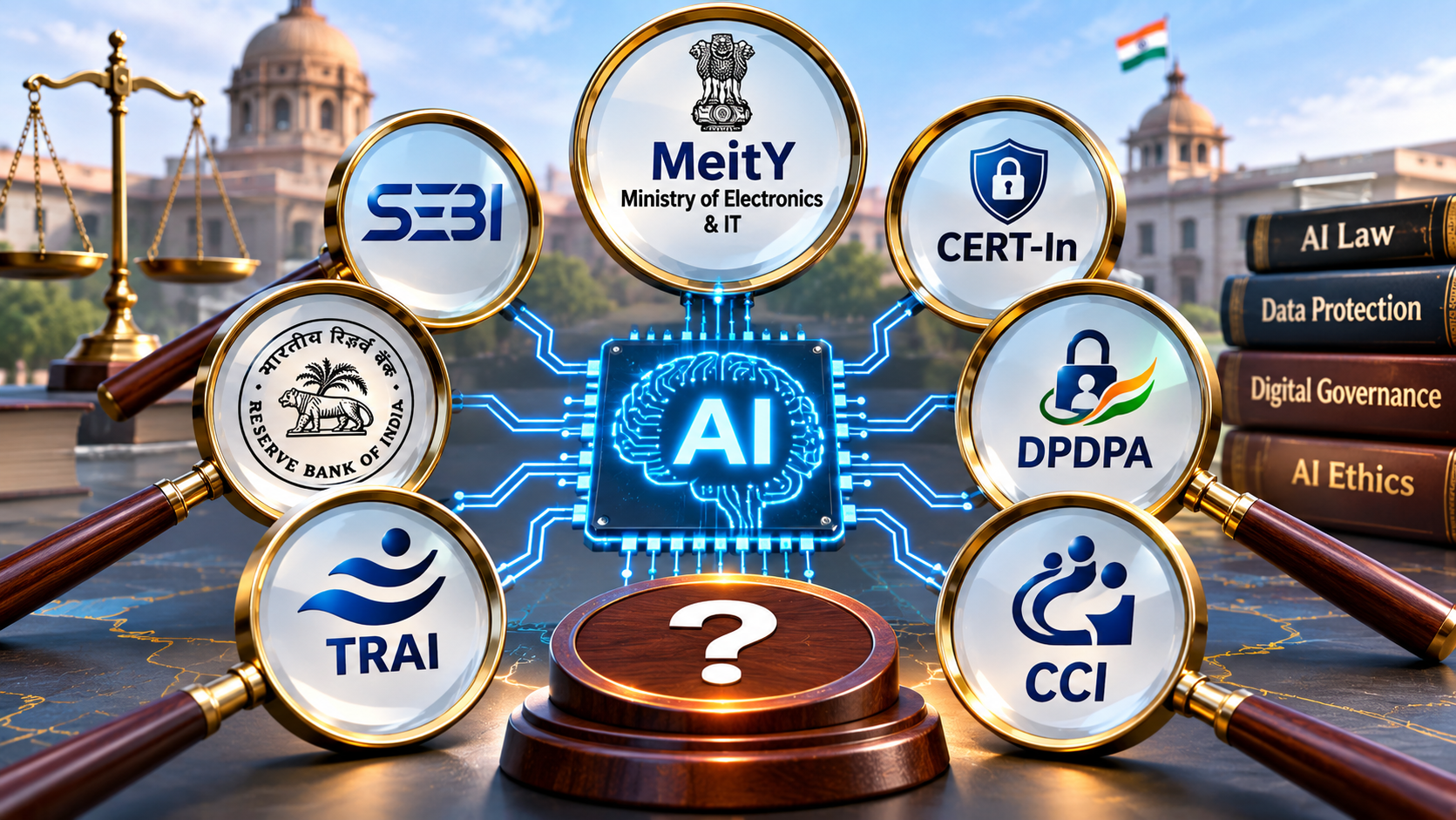
India’s distributed model is no longer merely a policy concept; it is already taking shape across individual sectors. Rather than establishing a single AI super-regulator, the country is asking existing institutions to govern AI within their respective mandates. This approach combines sector-specific enforcement with shared principles and growing coordination across government. Its ultimate test will be whether those institutions can respond consistently to risks that do not respect traditional regulatory boundaries.
The financial sector provides perhaps the clearest example. The Reserve Bank of India has examined both the opportunities presented by AI and concerns involving bias, explainability, governance and data protection. In August 2025, an RBI-appointed committee produced the Framework for Responsible and Ethical Enablement of Artificial Intelligence (FREE-AI) for the financial sector. Its aim is to encourage the use of AI while ensuring that decisions involving loans, payments, fraud detection and other financial services remain fair and reliable.
But the risks extend beyond banking. Would you trust an investment adviser more if they claimed artificial intelligence could deliver exceptional stock market returns?
That is precisely the sort of claim worrying the Securities and Exchange Board of India (SEBI). In October 2025, its chairman, Tuhin Kanta Pandey, warned that some market participants were exaggerating their use of AI to attract investors. The practice, known as 'AI-washing', can mislead investors into believing that sophisticated technology guarantees superior returns.
Such concerns are also shaping SEBI's regulatory approach. In August 2026, the regulator indicated that it would issue guidelines for the responsible use of AI and machine learning in in capital markets, with stricter safeguards for riskier applications, human oversight, “kill-switch” mechanisms and appropriate data controls. Crucially, accountability would remain with the regulated entity even when an AI tool is procured from a third party. That entity would still be responsible for investor data, the accuracy of outputs and compliance with the law.
Taken together, these sectoral developments reveal a clear direction of travel: regulators and public institutions are fashioning rules suited to their own domains. The next challenge is coordination. In April 2026, the government constituted the AI Governance and Economic Group as a high-level inter-ministerial body and central mechanism for AI governance policy development. It subsequently set up the Technology and Policy Expert Committee to provide specialised advice, while the India AI Safety Institute will focus on research, testing and safety standards.
What is emerging, then, is more than conventional sectoral regulation. Existing laws provide the foundation; specialist regulators address AI within their mandates; common principles operate horizontally; and central institutions supply expertise and coordination. Running through this architecture is one of the seven principles in the India AI Governance Guidelines: “Innovation over Restraint”. The government’s position is that governance should enable adoption while targeting actual risks, rather than impose automatic approvals or licensing merely because AI is involved.
Regulators are consequently encouraged to focus on real and present harm, particularly threats to life, livelihood or well-being, and to choose the effective but least burdensome instrument. Depending on the risk, that instrument may be an industry code, technical standard, advisory or binding regulation.
The guidelines acknowledge significant areas in which existing law may need to evolve: allocating liability among AI developers, deployers and users; applying data-protection principles to AI development; addressing misuse of generative AI; authenticating synthetic content; governing the use of copyrighted material in model training; managing risks in sensitive sectors; and responding to increasingly autonomous or agentic systems. These issues are difficult because responsibility may be divided across a chain of actors while the system’s operation remains opaque to the person affected.
Imagine receiving a frantic phone call from your daughter, saying she has been in an accident and urgently needs money. The voice sounds exactly like hers. You transfer the money, only to discover later that your daughter never called. A fraudster had used AI to clone her voice.
Now comes the difficult question: who is responsible? The telecom operator that carried the call? The company whose AI technology was used? The bank through which the money was transferred? And which regulator should intervene?
Such situations expose the limitations of regulating AI through separate institutions. In July 2023, the Telecom Regulatory Authority of India (TRAI) proposed an alternative: a common framework for responsible AI across industries and an independent statutory Artificial Intelligence and Data Authority of India.
TRAI also envisaged classifying AI use cases by risk and imposing differentiated obligations, particularly for high-risk applications. Its recommendations crystallise the central institutional question: can multiple regulators adequately address common AI risks, or will India eventually require a dedicated authority with statutory powers and cross-sectoral oversight?
For now, however, the government is sticking with its existing regulators, leaving the question of a single AI authority unresolved.
The debate is no longer whether AI should be regulated: it already is, through a patchwork of laws and institutions. The harder question is whether that patchwork can keep pace with a general-purpose and increasingly autonomous technology.
India may not need an AI Act today, but India may revisit its present approach and consider a more centralised, risk-based framework. A uniform system may also become necessary to provide certainty across sectors as AI becomes integral to business operations and investment decisions. The challenge will be to secure consistency without building a structure that inhibits useful innovation.