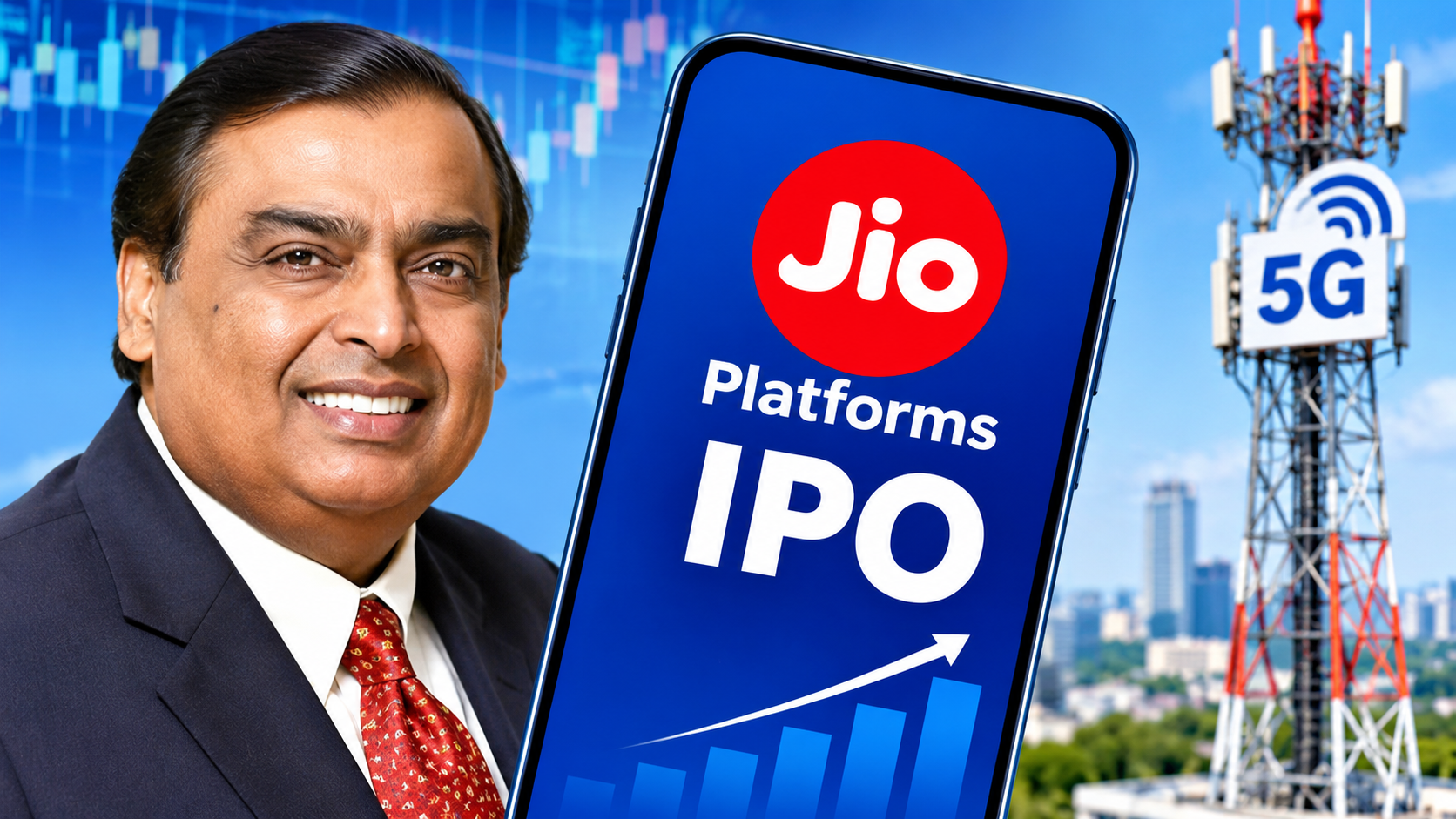
The NSE IPO was the blockbuster of the year. Now comes an even bigger showstopper from the Reliance stable: the much-anticipated Jio Platforms IPO, slated for the end of October. The company plans to raise upward of Rs 30,000 crore, making it the largest IPO in the history of the Indian capital markets.
Ten years ago, most Indian mobile users were still on 2G. Jio launched in 2016 with free voice and cheap data, crossed 100 million 4G customers in under 180 days, and by FY26 carried about 60 percent of India’s wireless data traffic.
However, as we always say, no company is good or bad; it is the valuation that makes it look good or bad for investors. That question awaits the determination of the price band. However, the DRHP (Detailed Red Herring Prospectus) does allow for a closer look at the business, the balance sheet and the cash flows.
Reliance Jio Infocomm Limited (RJIL), a unit of Jio Platforms, served 524.4 million customers as of March 31, 2026; which is more than the population of the United States.Of these, 268.5 million were on 5G, giving Jio the largest 5G customer base in the world outside China as of December 2025, while 27.1 million subscribed to home broadband.
How large is the next-biggest player?
The answer depends on what is measured. On total customers, Jio’s lead over Bharti Airtel’s India business is only 9%; on 4G and 5G customers, it is 1.4 times; on data carried, 2.4 times; and in home broadband, about 1.9 times. On revenue, the two are almost level, and on EBITDA, Bharti is about 8% ahead. In short, Jio runs the biggest network in India, but not yet the biggest profit pool.
What sets Jio apart ?
Four things, all from the DRHP. First, Jio is described as the only operator globally with an end-to-end in-house 5G stack, covering the core network, devices and operating and billing systems, backed by 6,817 patent applications. Second, spectrum—the invisible radio real estate on which mobile calls and data travel—is scarce, government-auctioned and central to both coverage and capacity. Jio holds the largest spectrum in India, at 26,800.8 MHz, and is the only Indian operator with 5G spectrum in all three bands—700 MHz, 3,300 MHz and 26 GHz.
Third, home broadband without fibre. Jio uses its own radio technology to deliver internet to homes without digging streets or laying last-mile cable. That has taken JioAirFiber to 12.9 million customers in about two years, giving it a 77.49% share of India’s advanced fixed-wireless access market—broadband delivered over radio waves rather than fibre cables. Fourth, reach. Jio’s distribution network spans 1,059 Jio Centres, 6,323 Jio Points (local outlets that provide customer services, including mobile connections, recharges and support) and the vast Reliance Retail network. This is reinforced by bundled entertainment content through JioHotstar, a video-streaming platform that competes with services such as Netflix and Amazon Prime Video, offering movies, television shows, sports and other entertainment.
From Equity Cult to Price Premium
Raising large sums of money through the capital markets is nothing new to the Reliance Group. The late founder of the group, Dhirubhai Ambani, is credited as the father of the Indian capital markets for building the "Equity Cult" and bringing millions of middle class retail investors into the stock markets.
The difference this time is that the IPO will be priced fairly high; expected to be over ₹1,000 for a ₹10 paid up share). However, this is not unusual in today's times, with hardly any IPO being priced around face value or a small premium!I remember the period in the early 1990s when we could get allotted MNC blue chips and today's leading companies' shares at throwaway prices. There are plenty of examples like Infosys, TVS Motors, Apollo Hospitals, etc., struggling to stay above their IPO price!
Nowadays, IPO sizes are larger and the issue also comes after several rounds of funding by private equity (PE) players. Current shareholders apart from Reliance include Meta, Google, and seven global investors, and none of them are selling now.
As many as 96 mainboard IPOs have raised ₹1,13,090 crore in 2026, and the ten largest account for ₹61,650 crore, or 54.5 percent of it. Size has not helped. Only four of the top ten trade above their issue price. Of the three issues above ₹9,000 crore, NSE is 3.0 percent below issue and SBI Funds Management 12.9 percent below; only Manipal Health is ahead, by 18.9 percent.
To sum up, Jio Platforms is a fine company but given the current market outlook there may not be significant listing gains. However, it is definitely worth adding to one's portfolio when there are dips in the market!
முந்தைய செய்தி
AI Regulation: Too Many Watchdogs, No One in Charge?
அடுத்த செய்தி
Is AI About to Trigger a SaaSpocalypse? Not Quite