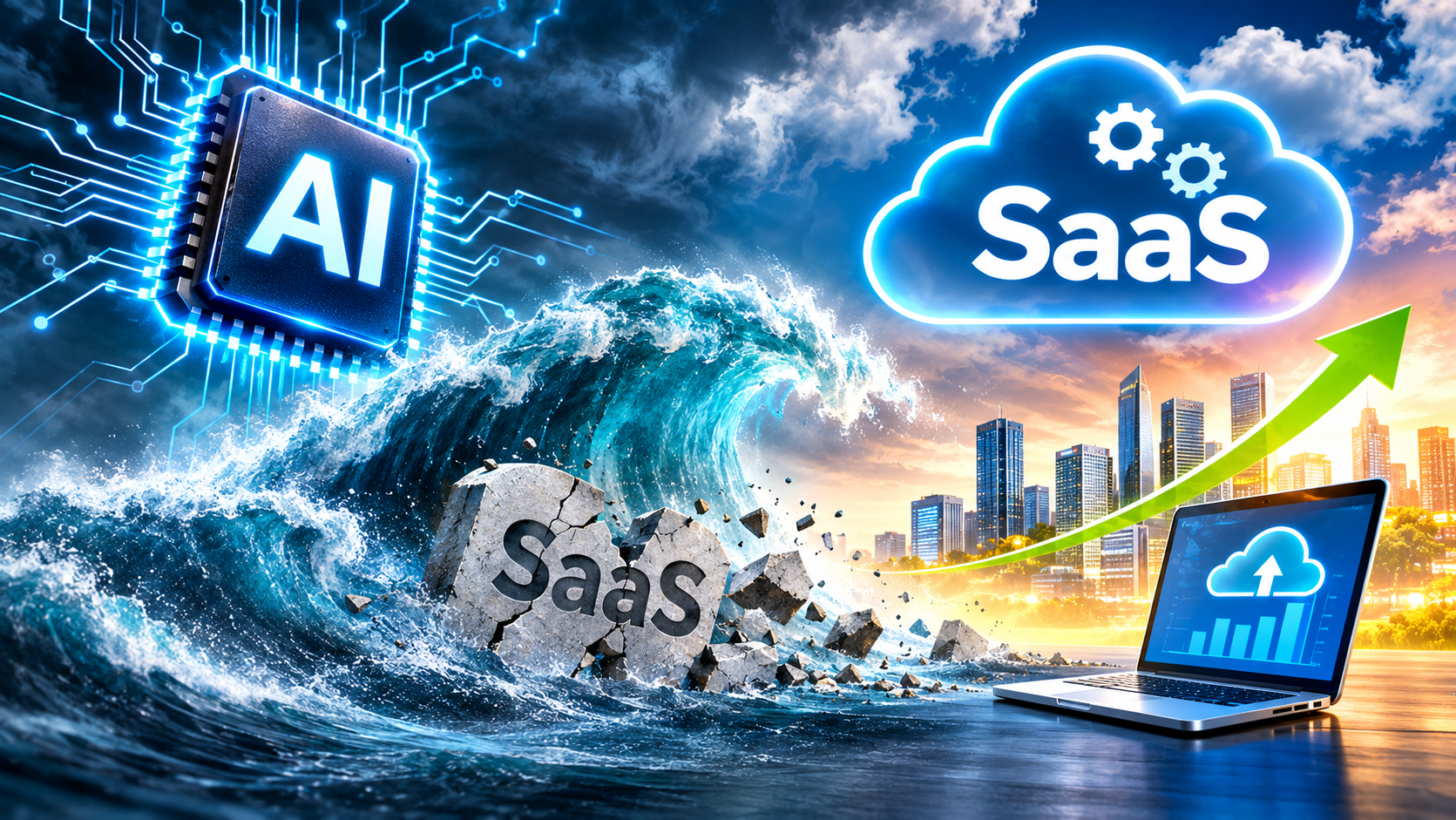
For nearly two decades, Software-as-a-Service, or SaaS, has been one of technology’s most successful business models. Companies stopped buying software once and installing it on their own servers. Instead, they paid a monthly or annual subscription to use products such as Salesforce, Workday, ServiceNow or thousands of smaller tools. India has built its own SaaS success stories, including Chennai-based Zoho, Freshworks, Chargebee and Kissflow, alongside companies such as Icertis, Darwinbox, BrowserStack and Whatfix.
Now AI has created a new fear: what if companies no longer need to buy software because they can simply build it themselves?
With today’s coding assistants and AI agents, a user can describe an application in plain English and get working software in hours. That has given rise to a dramatic term: the “SaaSpocalypse”.
The fear is not completely imaginary.
A 2026 Retool survey found that 35% of respondents had already replaced at least one SaaS tool with custom-built software. Gartner estimates that as much as $234 billion of enterprise application spending could be exposed to disruption from AI agents by 2030.
But does that mean SaaS is dying? I don’t think so. AI is more likely to change SaaS than destroy it.
The first thing AI changes is the economics of building software. Until recently, even a simple internal application required developers, designers, testing, infrastructure and months of work. Today AI can dramatically compress that effort. A company may reasonably ask why it should pay for an expensive software product when it needs only 20% of its features and can build exactly what it wants.
That is bad news for mediocre SaaS. Products that are little more than a database, a few forms, a dashboard and a simple workflow will find it increasingly difficult to justify premium subscription prices.
But creating software is only part of the problem. Imagine asking AI to build a payroll system. Producing the screens may become easy. But who ensures salaries are calculated correctly? Who protects employee data? Who updates tax rules? Who maintains integrations? Who provides audit trails? And who takes responsibility when something fails?
The cost of creating software is collapsing. The cost of operating trustworthy software is not disappearing.
The second big change may be even more important: the SaaS “seat” itself is under threat.
For years, SaaS companies grew by selling more licences. If 5,000 employees used an application, the customer might pay for 5,000 seats.
Now imagine an AI agent performing work across Salesforce, SAP and ServiceNow for hundreds of employees. Those employees may no longer need to open every application themselves. Suddenly the economics change. A company may need fewer human licences, while its AI agents perform thousands or millions of transactions through those same systems. This shift could push SaaS increasingly towards usage- and outcome-based pricing rather than traditional seat-based subscriptions.
So SaaS may survive while the familiar “per user, per month” business model changes dramatically.
There is another possibility that sounds paradoxical: AI could make some enterprise software less visible while making it more important.
Imagine asking an AI assistant: “Why did sales decline in Chennai last month?”
The AI could retrieve sales figures from Salesforce, inventory from SAP, campaign performance from Adobe and customer complaints from ServiceNow, analyse them together and give you an answer.
You may never open any of those applications. The interface has moved from software to AI.
But the trusted data, permissions, business rules and transactions still live inside those systems. The software has not disappeared. In some ways, it has become infrastructure.
That distinction will matter enormously. The question may no longer be whether employees love using an application, but whether AI agents can securely access it, understand it and reliably transact through it.
That points towards a very different future for SaaS.
The winners may no longer simply be the companies with the best screens or the largest number of features. They may be the companies that own trusted data, deep integrations, critical workflows and systems that AI agents can reliably use.
And there will be losers. If your product exists mainly because software used to be expensive and difficult to build, AI is an existential threat. If your product is deeply embedded in how a business operates, contains years of important data and can evolve into a platform for AI agents, the future looks very different.
So is a SaaSpocalypse coming? Probably not.
But the SaaS industry is entering something more interesting than an apocalypse: a reset.
AI will make software easier to create, reduce the value of some interfaces, challenge seat-based pricing and expose products that never had much of a moat. So in conclusion, SaaS is unlikely to disappear. But there will certainly be SaaS casualties.
முந்தைய செய்தி
Jio’s IPO Call: Great Network, Pricier Question
அடுத்த செய்தி
Can an engineered probiotic transform diabetes treatment? GIFT aims to find out