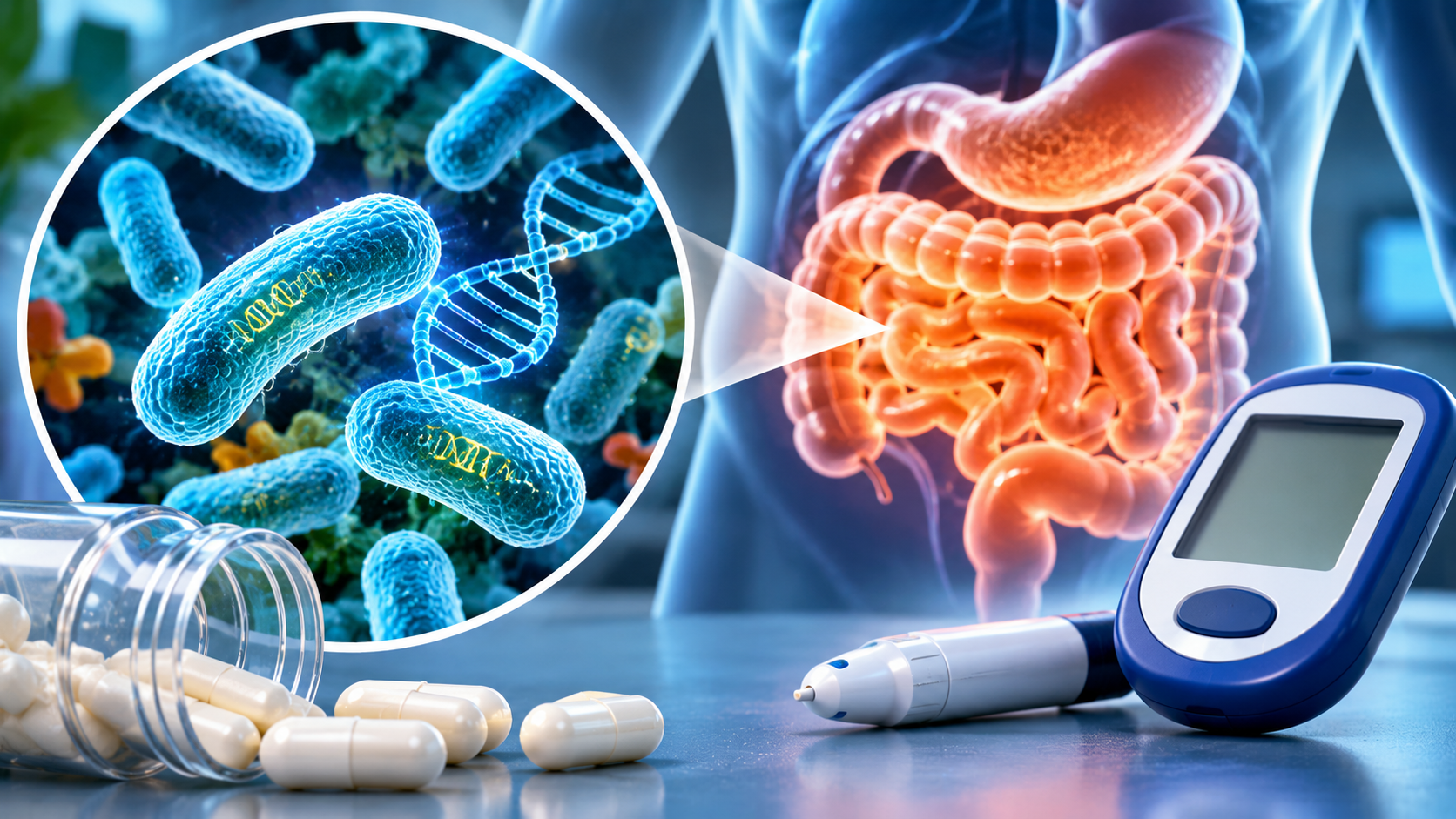
A bioengineered probiotic developed by researchers at East China Normal University in Shanghai could mark a new approach to diabetes treatment. In early animal studies, the experimental “living drug,” called GIFT, senses high blood glucose and releases the hormone GLP-1 only when needed.
If it proves safe and effective in human trials, GIFT could offer a “sense-and-respond” alternative to conventional GLP-1 drugs for diabetes and metabolic disease. For now, however, it remains preclinical: it has shown promise in animal models, but its efficacy and safety in people are unproven.scmp+1
GIFT stands for oral-deliverable glucose-sensing and functional-response probiotic. It is built from engineered probiotic bacteria that detect elevated blood sugar and autonomously secrete GLP-1—a gut hormone that stimulates insulin release after meals, slows digestion and reduces appetite. That is the same biological pathway targeted by GLP-1 medicines such as Ozempic and Wegovy.
The research, led by scientists at East China Normal University’s School of Life Sciences, was published in Nature on August 12.
Meet GIFT: a biological thermostat for blood sugar
Unlike conventional medicines that deliver a fixed dose regardless of the body’s real-time needs, GIFT is designed to remain largely inactive when blood glucose is stable. It switches on only when it detects glucose rising above a normal threshold.
Once activated, the engineered probiotic produces and releases glucagon-like peptide-1 (GLP-1), the gut hormone mimicked by blockbuster diabetes and weight-loss drugs such as Ozempic and Wegovy. GLP-1 prompts the pancreas to release insulin after meals, helping bring elevated blood sugar down.
As glucose levels fall back toward the normal range, the system is designed to scale back GLP-1 production. This feedback loop is intended to make treatment more responsive to the body’s needs and reduce the risk of hypoglycemia—dangerously low blood sugar. In early animal studies, researchers reported no indication of harmful effects, though human trials are still some way off.
What’s inside GIFT?
To build GIFT, lead scientist Ye Haifeng and his team started with Escherichia coli Nissle 1917, a harmless strain of E. coli already used in some commercial probiotic products. They then gave the bacterium two jobs: sense high blood sugar, and make a glucose-lowering hormone when needed.
The first component is the biosensor—essentially a molecular switch. It uses a protein called HexR, borrowed from Pseudomonas putida, another bacterium. When blood sugar is normal, the switch stays off. When sugar levels rise, the switch turns on.unwire+1
The second component is the payload: a set of genetic instructions, called an expression cassette, that tells the bacterium how to make human glucagon-like peptide-1 (GLP-1). GLP-1 is the same type of hormone targeted by diabetes and weight-loss drugs such as Ozempic and Wegovy.unwire+1
When glucose rises in the gut, the HexR switch activates and the bacteria begin producing GLP-1. That hormone then prompts the pancreas to release insulin, which helps move sugar out of the bloodstream and lowers blood glucose. As glucose returns to a normal range, the system is designed to wind down GLP-1 production.unwire+1
That built-in feedback is what makes GIFT potentially different from a standard fixed-dose medicine: it is intended to release treatment only when the body needs it, which could reduce the risk of hypoglycemia—dangerously low blood sugar. But this has so far been shown in animal studies, not human trials.
How GIFT senses blood sugar and responds with GLP-1
“GIFT offers a novel approach to precise blood glucose management in diabetes by coupling glucose sensing with on-demand GLP-1 secretion. It represents a significant advance in the field of engineered probiotic living drugs,” said Ye Haifeng, the paper’s corresponding author and a professor at East China Normal University’s School of Life Sciences.
Ye noted that, unlike therapies based on mammalian cells, oral probiotics avoid the complexity and immune-related risks associated with cell transplantation. Compared with engineered bacteria that continuously produce GLP-1, he said, GIFT’s glucose-triggered system offers better stability, druggability and safety.
In plain terms, GIFT is designed to act like a self-regulating treatment: it releases GLP-1 when blood sugar is high and scales back once glucose returns to a healthier range. That could, in principle, reduce the risk of hypoglycemia—dangerously low blood sugar—compared with a treatment that releases the hormone continuously.
These remain the researchers’ claims based on animal studies. GIFT has not yet been tested in human clinical trials, and its long-term safety, stability and effectiveness in people are still unproven.
Efficacy data: what the mouse and monkey studies showed
The preclinical findings published in Nature suggest that GIFT can help manage blood sugar over both the short and longer term—though only in animals, not yet in people.
In diabetic mice, repeated oral dosing with GIFT significantly lowered fasting blood sugar and improved glucose tolerance and insulin sensitivity. Over the treatment period, levels of glycated haemoglobin (HbA1c)—a longer-term marker of average blood sugar control—also fell.
The benefits appeared to extend beyond glucose control. Treated mice showed reduced liver fat, fewer markers of kidney injury and lower inflammation in the colon. These are encouraging signals for diabetes-related complications, but they are not proof that GIFT can reverse fatty liver disease or kidney damage in patients.
In diabetic cynomolgus macaques, a single oral dose triggered GLP-1 and insulin release. The researchers observed glycaemic control—blood sugar remaining within a managed range—for up to 72 hours after dosing. A separate five-week study in diabetic monkeys found consistent glucose control and a favourable short-term safety profile.
Commercial implications and market viability
For investors and pharmaceutical companies, GIFT’s appeal lies in its potential to combine the convenience of an oral therapy with the self-regulating action of a glucose-responsive GLP-1 treatment. If it works in people, it could tap one of the largest and fastest-growing markets in modern medicine.
The research team says it has secured key patents and is scaling manufacturing to meet regulatory standards in the United States and Europe. Its most striking commercial claim is timing: the researchers have said GIFT could reach the US market as a dietary supplement within 24 months, subject to regulatory clearance.
That timeline is ambitious. Dietary supplements face different—and generally less demanding—rules than prescription drugs, but a product claiming to treat diabetes or produce GLP-1 would invite close scrutiny from regulators. Human clinical data, manufacturing consistency and long-term safety will ultimately determine whether GIFT becomes a supplement, a prescription therapy, or neither.
The intellectual property may be the more durable commercial asset. GIFT’s “sensor-and-payload” design is modular: by changing the glucose sensor or the therapeutic gene, the same engineered bacterial chassis could, in principle, be reprogrammed for other metabolic conditions. That makes it a potential platform technology rather than a single-product bet—though the platform’s value depends entirely on whether it can clear human trials.
Why access may matter as much as innovation
The history of blockbuster drugs shows that scientific success does not guarantee affordable access. In 2015, Turing Pharmaceuticals, then led by Martin Shkreli, acquired the US rights to Daraprim, a decades-old drug used by some HIV and cancer patients, and raised its price from $13.50 to $750 a pill—an increase of more than 5,000%.bbc+1
The episode became a shorthand for the risks of monopoly pricing in medicines with few substitutes. For a GLP-1-like living drug, the commercial question will therefore be not only whether GIFT works, but whether its developers can produce it at a cost that allows broad access—or whether patent protection and manufacturing complexity keep prices high.bbc+1
India’s experience with antiretroviral drugs offers a useful counterpoint. Indian generic manufacturers helped drive down the cost of HIV treatment globally, expanding access across Africa and other low- and middle-income countries after patent barriers were challenged and generic competition took hold. That history shows how generic entry can transform a life-saving therapy from a niche, high-cost product into a public-health tool.
A more recent Indian example is bedaquiline, a key drug for drug-resistant tuberculosis. TB survivors Nandita Venkatesan and Phumeza Tisile filed a pre-grant opposition to Johnson & Johnson’s attempt to extend patent protection on the drug; India’s patent office upheld the opposition in 2023, helping clear the way for more affordable generic versions.
For GIFT, the lesson is that patents can fund innovation—but they can also determine who gets the therapy, at what price, and how quickly. If the Shanghai team’s platform proves safe and effective, the commercial battle may be less about whether the science works than about who controls the manufacturing, patents and distribution needed to bring it to patients at scale.