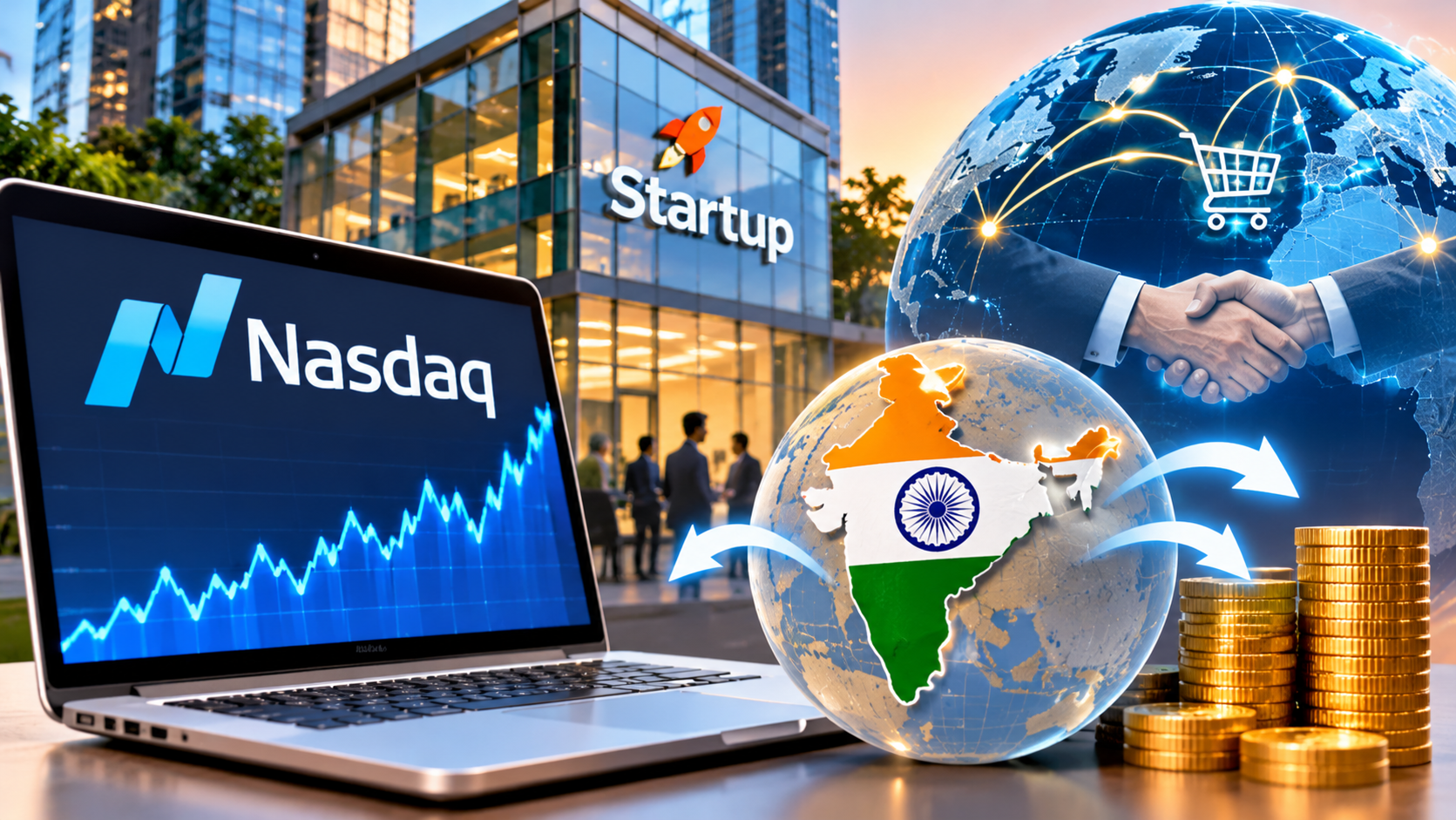
India’s public markets today are at an interesting inflection point. There’s already a large pipeline of technology-led companies gearing up for their public debut in India. Adding to the queue is a growing number of Indian-origin technology and consumer companies moving their overseas holding structures back home ahead of potential public listings.
Companies such as PhonePe, Razorpay, Groww, Pine Labs, Zepto, Meesho and Flipkart have either completed, announced or been associated with reverse-flip plans. These companies had set up holding companies overseas and are now willing to bring those structures back to India. The question is: Why?
To answer that question let’s take a dive into the world of venture capital, which has created our technology-first companies, sometimes decades old but still charmingly coming under the sobrequiet of a “startup.” And these have the potential to scale non-linearly. For instance, a restaurant that wants to increase its revenue tenfold will usually need to open more outlets, build more kitchens, buy more equipment and hire more people, which means its costs and investments rise substantially as the business expands. A software company, by contrast, can potentially grow its revenue from ₹100 crore to ₹1,000 crore using largely the same technology platform, without having to increase its spending on physical infrastructure at anything close to the same rate.
Building that technology business in the first place can still be expensive. Companies may spend heavily for years developing their products, attracting customers, advertising their services and convincing consumers to adopt something new, which is why many fast-growing technology companies initially burn cash and report huge losses. Once the product and customer base are established, however, the economics can change dramatically: the same platform can serve millions of additional users at a relatively small additional cost, allowing revenue to grow much faster than expenses and eventually generating much higher profit margins.
Many of these fast-growing technology companies can become extremely valuable long before they become profitable. They may have millions of customers and rapidly rising revenues, but still report losses because they are spending heavily on technology, marketing and expansion in the hope of building a much larger business.
Historically, India’s public markets were not well equipped to value such companies. Listing rules and investors were more accustomed to traditional businesses that had established profits and could be valued on the earnings they were already generating. Investors had far less experience assessing a technology company whose value depended not on today’s profits, but on how quickly its revenues could grow, how large its market could eventually become and how much money it might make once it reached scale.
If India could not value the business, founders went to the market that could. The US had a slew of investors, who understood technology, accepted losses for future growth and valued companies on revenue, market opportunity and long-term economics rather than simply current profits. That is one reason so many Indian-origin companies were incorporated overseas, with Nasdaq as the north star. Nasdaq became important not simply as another stock exchange, but as the natural public-market home for companies whose economics differed fundamentally from traditional businesses — companies where technology allowed revenues and profits to scale much faster than capital.
But that is changing. After years of building businesses and developing its venture-capital ecosystem, India now has the liquidity, institutions and experience to value them. Understand the potential of the likes of Zomato, Nykaa, Policybazaar and Delhivery.
I believe India is now creating its own Nasdaq equivalent — not as a separate stock exchange, but as a market willing to back technology-led companies.
And the numbers tell the story. Around 30 Indian technology-led companies with genuine technology moats – an advantage created by technology that competitors cannot easily copy or overcome; and non-linear scalability have listed in recent years. Only around 40% were profitable, yet they came to market at a median market capitalisation of roughly ₹8,000–10,000 crore and around 7x EV/Revenue. Compare that with the US. Over the last six years, the median technology company coming to Nasdaq has been valued at roughly $3 billion, almost three times the size of the typical Indian company.
For founders, this changes the calculation dramatically. A company that once went overseas because it couldn’t list in India may now find that India is where it can list at one-third the scale at a 40% higher valuation.
That helps explain the reverse flip.
And founders and investors are willing to pay a significant price to make this move. A reverse flip can result in a substantial tax bill because moving the company back to India may require investors to exchange their shares in the overseas parent for shares in a new Indian parent company. For tax purposes, that exchange can effectively be treated as if the overseas shares had been sold, even though investors have not actually cashed out or received money from their investment. There were efforts to make reverse flips less costly from a tax perspective, but the wider relief that founders and investors had hoped for did not materialise. Despite the potential tax bill and the complexity involved, companies are still choosing to come back to India.
But the IPO story is only half the story.
Once an Indian startup is listed and commands a strong valuation, its stock becomes a currency. It can issue shares to acquire another business rather than relying only on cash or debt. Its valuation itself becomes a source of purchasing power. And this opens up another opportunity.
Indian companies do not necessarily need to buy startups. Thousands of profitable mid-sized businesses in Europe and the US face succession problems as founders age and the next generation chooses not to take over. Many are too small to interest large global buyers, yet are established brands with steady cash flows.
That creates an interesting opportunity. An Indian technology company valued by the market at 7–10 times its annual revenue could potentially use its highly valued shares to acquire a profitable overseas company available at just 1–3 times revenue. The deal could add both revenue and profits to the Indian company.
This can create a virtuous cycle: a high valuation helps fund acquisitions, which add revenues and profits and can push the valuation higher, providing more firepower for the next deal. But it works only if the acquisitions are successfully integrated.
For years, Indian technology companies looked overseas for the capital and valuations they could not find at home. That equation is beginning to reverse. India’s public markets can now give some of these companies the valuations they need not only to list at home, but also to expand abroad.
Indian traders on the Silk Route have historically followed a simple formula: buy from China and sell to the world. India’s newly listed companies could take that idea much further by buying profitable businesses from the world and bringing their technology, brands, customers and cash flows into Indian companies.
The reverse flip may therefore be only the beginning. Companies are coming home to list and their next move could be to use those Indian valuations to go shopping around the world.
முந்தைய செய்தி
India’s Growth Story Now Runs on Renewable Energy
அடுத்த செய்தி
Bears Before the Fireworks? A Deepavali Market Check