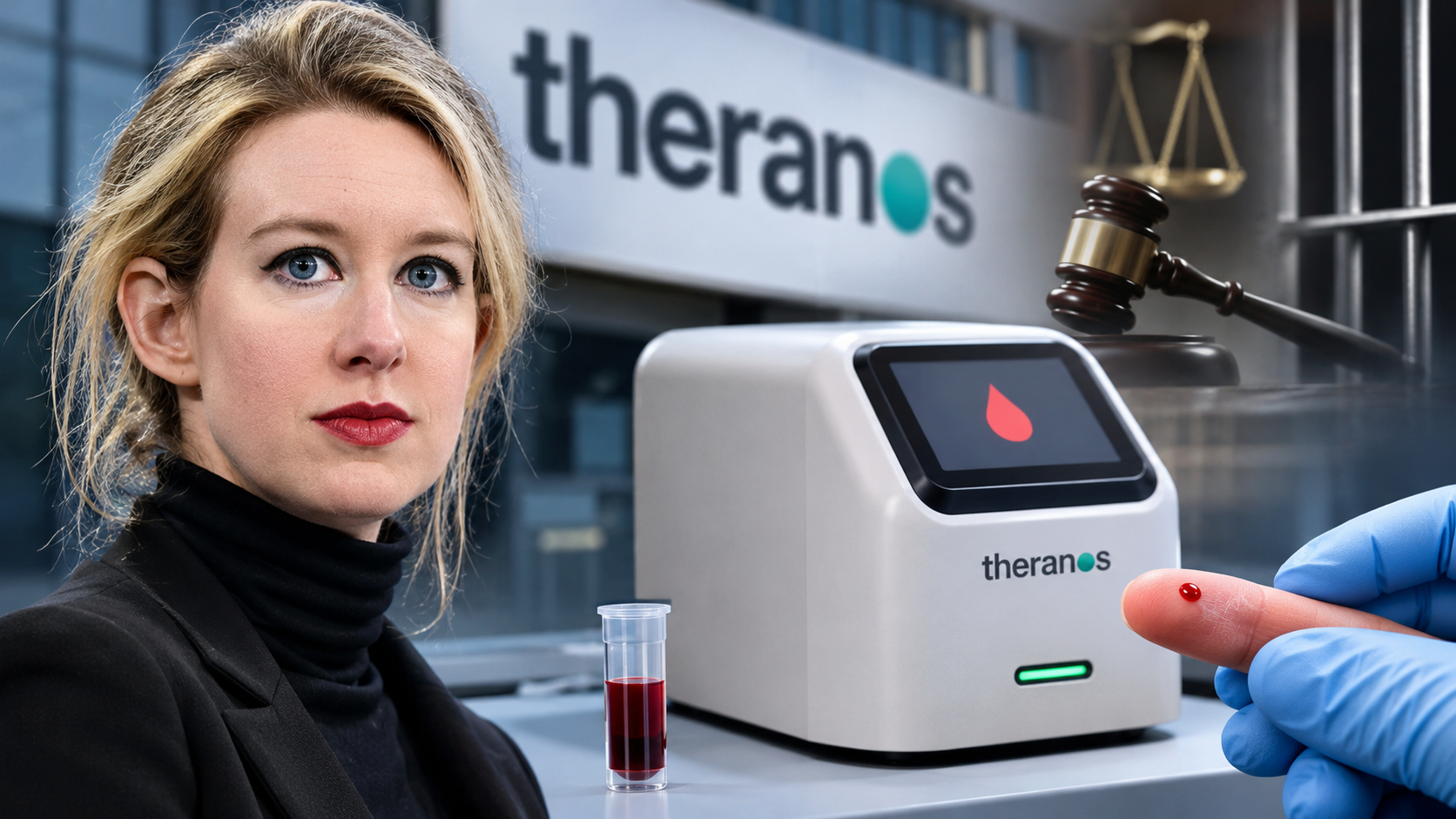
The sight of a needle can make grown adults faint, children cry, and even the most stoic patients flinch. She was 19 years old, standing in a Stanford laboratory, convinced she could change the world’s view on one of its unspoken yet universal fears, “tyranophobia” – the fear of needle pricks. It was an idea that would attract nearly a billion dollars from some of the world’s most sophisticated investors. It would make her a billionaire at 30, put her on magazine covers, and inspire comparisons to Steve Jobs. It was also impossible. And yet, for more than a decade, almost no one asked the right questions.
The Pitch That Seduced Silicon Valley
In 2003, Holmes dropped out of Stanford and founded Theranos. The name in itself was convincing to people because it combined the terms therapy and diagnosis. Her pitch was simple: a proprietary device called Edison that could run comprehensive blood tests from a microscopic sample. No venipuncture, no waiting rooms. Just a finger prick, and all the results would arrive. No multiple pricks, no long needles. This was her unique selling point.
But there’s a biological reality that few wanted to discuss. Let me be clear about something fundamental. Blood is not a simple liquid. It is a dynamic fluid, a complex composition of cells, proteins and other chemicals. When a phlebotomist performs a standard venipuncture, they typically withdraw several thousand microlitres of venous blood. On the other hand, a finger prick may yield just 25 to 50 microlitres of capillary blood, depending on the collection method. Capillary samples can be contaminated by interstitial fluid and intracellular contents, and may contain microclots caused by improper collection or tissue compression. For a trained pathologist to assert that multiple tests, from potassium levels to complex oncology markers, could be performed accurately on such a small sample would require rigorous validation. But Holmes framed conventional blood collection as an unnecessary user experience defect. Conventional venipuncture is not used because health systems enjoy patient discomfort. It is used because many clinical tests require sufficient sample volume and reliable specimen quality.
Theranos confused biological necessity with operational friction. And the investors, who were impressed by the prospect of tapping into needle-averse consumer demand, failed to figure out these physiological constraints back then.
‘The Trade Secret’
The company’s proprietary device, Edison, produced wildly inconsistent results. To compensate, Theranos began diluting patient samples and running them on modified commercial Siemens analysers, while claiming that its proprietary technology was operating end to end. Holmes used “trade secrets” as her ultimate shield, deflecting inquiries from regulators, investors and the media with claims of proprietary technology. To her, independent verification and peer-reviewed publications were rules meant only for lesser competitors.
Rather than drawing standard blood vials, Holmes relied on a single finger prick, heavily diluting the micro-sample to run certain tests on third-party machines. Investors, hypnotised by the prospect of software-style valuations, bought the gimmick wholesale, failing to recognise the discrepancies between the company's scientific claims and its actual capabilities. By operating under a regulatory framework that did not require routine FDA premarket review of laboratory-developed tests, Theranos avoided certain forms of FDA scrutiny for years. Internally, Holmes consolidated control through super-voting stock, while the company populated its board with politicians and financiers instead of medical experts. In the end, financial models failed to catch what rigorous scientific scrutiny might have revealed.
The Exposé: Brought Down by the Press
The $9 billion Theranos illusion didn’t unravel in a boardroom; it was dismantled by the press. In 2015, Wall Street Journal reporter John Carreyrou began investigating tips from former employees, some of whom had faced threats of lawsuits for questioning the company’s internal data. Despite aggressive legal intimidation from Theranos and its lawyers, Carreyrou dropped his bombshell on October 15, 2015. He revealed that Theranos’s proprietary “Edison” machines were unreliable and that the company was secretly running most tests on standard commercial machines. Holmes dismissed the report on CNBC as a “tabloid smear campaign”, but the spell was irrevocably broken.
The corporate death spiral was swift and devastating. January 2016: A federal Centers for Medicare & Medicaid Services (CMS) inspection report on Theranos’s Newark laboratory revealed serious deficiencies, including quality-control failures that posed an immediate risk to patient safety. June 2016: The retail house of cards collapsed as Walgreens terminated its partnership with Theranos, while Safeway had already ended its relationship with the company in 2015. July 2016: CMS revoked Theranos’s laboratory certification and banned Holmes from owning, operating or directing a laboratory for at least two years. May 2016: Theranos voided two years of patient test results from its proprietary machines. This included approximately 31,000 reports issued to Walgreens customers, representing 11.3% of customers who had used the service.
Patients were left agonising over the validity of their cancer screens, pregnancy tests and blood-thinner levels. By 2018, the company’s valuation had effectively collapsed to zero.
The founders faced severe legal consequences. Following a 2018 SEC fraud settlement that required Holmes to surrender millions of shares and barred her from public corporate leadership for 10 years, federal judges handed down prison sentences in 2022: 11 years and 3 months for Holmes, and 12 years and 11 months for Balwani.
But the macroeconomic shockwaves persist. More than $700 million in capital was raised through misleading claims; money that could have funded legitimate diagnostic research. The FDA subsequently sought to tighten oversight of laboratory-developed tests (LDTs), potentially increasing validation costs for new startups, but its 2024 rule was struck down by a federal court in 2025. Furthermore, the fallout may have created an unfair chilling effect on female-led biotech ventures and served as a stark warning for emerging, fragmented diagnostic markets like India’s, demonstrating that scaling without strict quality control invites systemic ruin.
The Blueprint for Healthtech Due Diligence
As capital floods into AI diagnostics and synthetic biology, investment committees must adhere to three non-negotiable rules to prevent the next Theranos:
Mandate Domain Experts: Financial modelling cannot evaluate biological risk. Practising clinicians, pathologists and bioengineers must hold voting seats on investment committees.
Require Independent Data: Proprietary “black boxes” cannot hide behind trade secret exemptions. Third-party, peer-reviewed validation is the baseline for commercialisation.
Price the Clinical Downside: Biological failure exacts a human toll. The downstream costs of false diagnostics; repeated tests, delayed treatments and acute patient anxiety; will ultimately break the business.
Theranos is a masterclass in what happens when the economics of innovation outpace the economics of evidence. In healthcare, trust is not a marketing asset; it is a clinical prerequisite.
The collapse of Theranos is often recounted as a narrative of corporate fraud and individual hubris. But through the lens of healthcare economics, it stands as a classic case study in the breakdown of institutional due diligence caused by extreme information asymmetry, misapplied software valuation models and the failure to price biology.