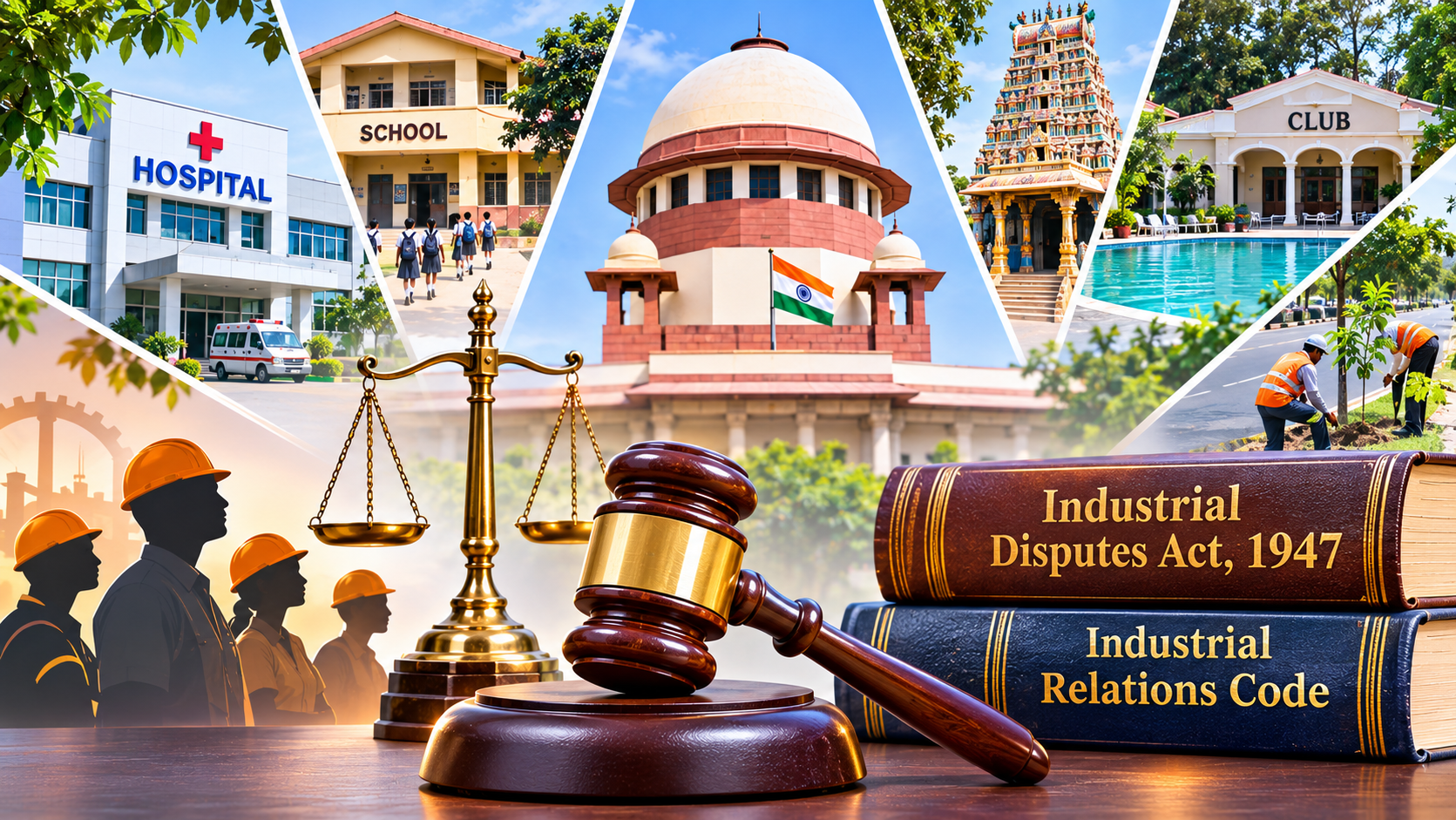
For nearly eighty years, Indian employers and workers have debated a single word: “industry”. Does it include a hospital, school, temple trust, club, or government department that plants roadside trees?
The answer has serious consequences. If an organisation is an “industry” under the Industrial Disputes Act, 1947, its workers may approach a Labour Court for reinstatement, back wages, or retrenchment compensation. If not, they may be left with only a slow civil suit—or no remedy at all. In thousands of cases, this threshold question has delayed consideration of the underlying dispute.
On 20 August 2026, a nine-judge Bench of the Supreme Court finally resolved the issue in State of Uttar Pradesh v. Jai Bir Singh. Put simply, earlier cases remain governed by the old law, while the new Industrial Relations Code must be interpreted on its own terms.
How we got here
The case arose from a dispute involving workers engaged under a tree-planting welfare scheme administered by Uttar Pradesh’s Social Forestry Department. The State contended that such a scheme could not be treated as an “industry”, while the workers asserted that it fell within the statutory definition.
In deciding the issue, the Supreme Court considered the principles laid down earlier by a seven-judge Bench in the 1978 Bangalore Water Supply judgment. Speaking principally through Justice V.R. Krishna Iyer, the Court formulated the following “triple test” for determining whether an activity constitutes an industry:
The answer turned on the principles laid down by a seven-judge Bench in the 1978 Bangalore Water Supply judgment. In that decision, the Court, speaking principally through Justice V.R. Krishna Iyer, formulated the following “triple test” for determining whether an activity constitutes an industry:
- a systematic activity;
- cooperation between employer and employee; and
- the production or distribution of goods or services intended to satisfy human wants, excluding purely spiritual or religious services.
The Court held that profit motive is irrelevant and that charitable institutions and public bodies may also qualify as industries. What matters is the nature of the activity, not the identity of the employer. In a composite undertaking, its character is determined by the predominant nature of its services. Only the State’s core sovereign functions were excluded.
The decision brought hospitals, educational institutions, clubs, research bodies and many government departments within the reach of labour law. Concerned that the definition had become too wide, a five-judge Bench referred the issue to a larger Bench in 2005, where it remained pending for more than two decades.
What the nine judges said
The judges wrote five separate opinions.
The Hon’ble Chief Justice, writing for four judges, felt the 1978 test was too wide. In his view, an activity should also have a “discernible commercial character”, something similar to trade or business, before it counts as an industry. Profit would still be irrelevant, but pure welfare or charity work could fall outside.
Three other judges, Hon’ble Justices B.V. Nagarathna, Dipankar Datta and Ujjal Bhuyan, disagreed. For them, the 1978 judgment was correct and the reference itself was unnecessary. Justice Datta put it plainly: institutional credibility lies in respecting finality, not in keeping doubts alive.
Justice Joymalya Bagchi agreed the reference was valid, but on merits he sided with the 1978 test. He also held that welfare schemes run by government departments do not escape labour law just because they serve the public good.
Justice P.S. Narasimha took a practical line. Since the old Act has been repealed, why create a third set of rules only for pending cases?
The bottom line
Yet the judges agreed on two things.
First, every case still pending under the old Act will be decided by the 1978 triple test. Even the Chief Justice’s reworded test will not apply to them. Closed cases will not be reopened.
Second, the definition of “industry” in the new law must be read on its own words. The 1978 judgment is not to be its “sheet anchor”.
So a worker who has fought a case for fifteen years will not suddenly be told his employer is not an industry after all. Justice Narasimha said that would be “a sad story”. That concern carried the day.
The new definition, and from when it applies
The Industrial Disputes Act was repealed, and the Industrial Relations Code, 2020 came into force, on 21 November 2025. Section 2(p) of the Code defines “industry” as any systematic activity carried on by cooperation between an employer and workers, whether employed directly or through a contractor or agency, for producing, supplying or distributing goods or services to satisfy human wants or wishes (other than purely spiritual or religious ones). It does not matter whether capital is invested or whether there is a profit motive.
In essence, the Code codifies the 1978 triple test. Its key change is to exclude four categories from the definition of “industry”:
- institutions owned or managed by organisations devoted wholly or substantially to charitable, social, or philanthropic services;
- government activities relating to sovereign functions, including all activities of Central Government departments dealing with defence research, atomic energy and space;
- domestic services; and
- any other activity excluded by notification of the Central Government.
The new definition applies only prospectively. As Justice Narasimha observed, disputes concerning periods before 21 November 2025 remain governed by the former Section 2(j), as interpreted in 1978.
What this means for businesses in Tamil Nadu
Employers with old disputes pending before Labour Courts in Chennai, Coimbatore or Madurai should not expect this judgment to help them. The 1978 law applies, and it is wide.
None of the Code’s exclusions has yet been tested in the Supreme Court. Expect fresh litigation on what “substantially” charitable means, and on how far a department can call its work “sovereign”.
This matters for our state, with its many trust-run hospitals, private colleges, temple bodies and cooperative societies employing thousands. Any such organisation should check two things: whether a dispute relates to the period before or after 21 November 2025, and whether its actual activities, not just its trust deed, fit the new exclusions.
A closing thought
Justice Krishna Iyer, back in 1978, called his own judgment a temporary answer and asked Parliament to write a better definition. The Supreme Court has now refused to rewrite the rules for cases already in the system, and left the new law to be read fresh.
Old cases get certainty. New ones get a clean start. The only regret is that the workers who started this fight had to wait more than two decades to hear it.
.