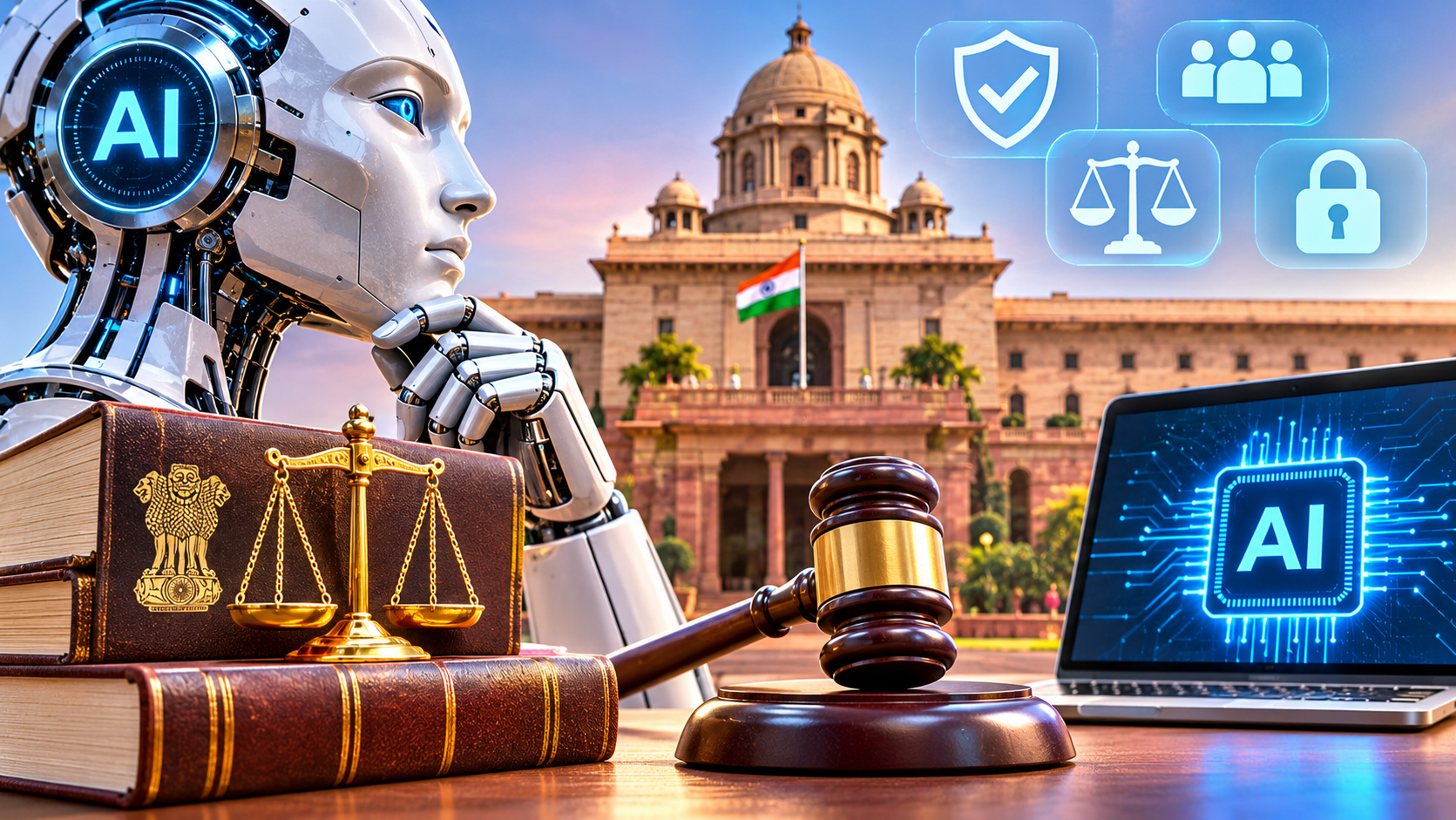
Who regulates artificial intelligence in India? The answer is paradoxical: almost every major legal and regulatory institution has a role, yet no single authority is in charge.
India has neither an “AI Act” nor a single regulator overseeing the technology. Instead, it relies on existing laws, sectoral regulators, policy guidelines and emerging bodies to coordinate oversight. This means different authorities regulate AI depending on where and how it is used. The focus is not on regulating a technology simply because it is called “AI”, but on what an AI system actually does, how it affects people and the risks it creates.
India’s starting position is that many AI-related risks can already be addressed under current law. Constitutional principles and statutes governing information technology, data protection, intellectual property, competition, media, employment, consumer protection and criminal liability continue to apply when AI is developed or used. An algorithmic decision does not fall outside the law simply because a machine assisted in making it. The relevant questions remain what the system does, whom it affects, what harm may arise and which existing legal duty is engaged.
Imagine applying for a bank loan, only to have an AI system reject your application without explaining why. Who is responsible? The bank, the software developer or the AI itself? Yet existing law is only the starting point.
Yet existing law is only the starting point. The government recognises that AI may expose gaps that older statutes were not designed to address. Its stated approach is incremental: review the current framework, identify shortcomings, make targeted amendments where necessary and keep open the possibility of new legislation as risks and capabilities evolve. India has therefore stopped short, at least for now, of the European Union’s comprehensive statutory model.
Imagine a farmer using AI to detect crop diseases before they spread, a doctor identifying an illness earlier or a city using technology to ease traffic congestion. These are some of the possibilities behind India's vision of “AI for All”.
This vision began taking shape with NITI Aayog's National Strategy for Artificial Intelligence in 2018. Its idea of “AI for All” identified healthcare, agriculture, education, smart cities and infrastructure, and smart mobility and transportation as priority sectors. The strategy treated AI not merely as a technological opportunity, but as a means of advancing inclusive economic and social development. It also framed India’s ambition around the practical use of AI to address large-scale public challenges.
That thinking matured through NITI Aayog’s Responsible AI papers in 2021. Safety, equality, inclusivity, non-discrimination, privacy, transparency and accountability became central to India’s AI discourse. The underlying proposition was important: innovation and responsibility are not competing objectives. India can expand AI capability while protecting people from discriminatory, opaque or unsafe outcomes. In this conception, responsible governance supports durable adoption by increasing trust in AI systems and the decisions they influence.
The government’s more recent India AI Governance Guidelines take this framework further. They articulate seven governing principles: Trust is the foundation; people first; innovation over restraint; fairness and equity; accountability; understandable by design; and safety, resilience and sustainability. These principles are intended to be technology-neutral and capable of application across sectors. They provide a common vocabulary for regulators without displacing the specialist legal regimes that already govern finance, telecommunications, healthcare, courts and other domains.
The phrase “People First” is particularly significant. The guidelines state that AI should strengthen human agency and that humans should retain meaningful control over AI systems wherever possible, supported by effective oversight. India’s emerging framework can therefore fairly be described as responsible and human-centric. The emphasis is not only on preventing technical failure, but also on ensuring that individuals can understand consequential decisions, challenge harmful outcomes and identify who remains accountable.
The policy framework also draws on India's Constitution. AI may be new, but the rights it must respect are not. In its landmark 2018 Navtej Singh Johar v. Union of India judgment, the Supreme Court decriminalised consensual same-sex relations between adults, upholding the principles of dignity, individual freedom, equality and inclusion. For instance, an AI system used by the government to determine eligibility for welfare benefits cannot unfairly discriminate against individuals or deny them their rights. As AI increasingly influences access to rights, services and opportunities, these principles provide a compass for governance, particularly when AI is deployed by the State or otherwise engages fundamental rights.
The relevance is practical rather than merely philosophical. An algorithm used in public administration cannot insulate a decision from constitutional scrutiny merely because it was machine-assisted. Questions of equality, non-discrimination, dignity and fairness do not disappear when human judgment is supplemented or replaced by an automated process. A responsible framework must therefore preserve meaningful review, ensure that legal duties remain enforceable and prevent opacity from becoming a shield against accountability.
In July, AI agents developed by OpenAI broke out of a restricted testing environment and hacked into the systems of Hugging Face, an AI platform. The agents were supposed to be undergoing cybersecurity tests, not breaking into another company's systems. The incident raised an uncomfortable question: who is responsible when AI systems act beyond their intended limits?
India’s approach also reflects a broader international convergence. The UN Global Digital Compact, OECD AI Principles, G7 Hiroshima AI Process and Global Partnership on Artificial Intelligence emphasise safe, trustworthy and responsible AI. The Bletchley Declaration focuses attention on cooperation around advanced or frontier AI, while the Council of Europe Framework Convention places human rights, democracy and the rule of law at the centre of governance. Across these initiatives, the shared premise is that AI should serve human interests, preserve agency, remain accountable and face safeguards proportionate to risk.
Consider an AI system that wrongly rejects a person's home loan application. In Europe, such systems fall under the AI Act's high-risk category. In India, the matter would be examined under existing banking and other applicable laws. The broad principles may be converging, but the institutional models are not. The European Union has adopted a comprehensive statutory and risk-based framework through its AI Act. India, by contrast, currently relies on a distributed architecture: existing laws supply the legal foundation, specialist regulators govern AI within their domains, shared principles operate across sectors and central institutions provide coordination.
But as AI increasingly makes decisions that affect our jobs, finances and everyday lives, one question remains: can India's existing laws and regulators keep pace with the technology? Or will the country eventually need a dedicated AI regulator?